

If you run a plumbing, electrical or building firm, word of mouth only stretches so far. The State of UK Trade Marketing 2026 report puts digital ad spend across UK trades at between £180 million and £240 million this year, and describes most of it as underperforming. That matters even if you spend nothing on ads, because your competitors do. The same data shows where UK trade business marketing actually pays: a Google Business Profile someone properly manages, a fast site, steady reviews, and facts that AI assistants can read and repeat.
What the numbers say
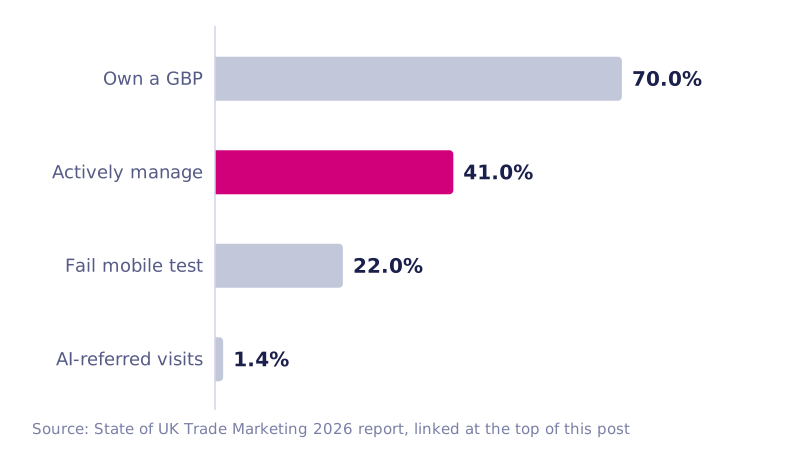
Around 70% of UK trade businesses have a Google Business Profile. Only 41% actively manage theirs. The rest claimed the listing and left it: out-of-date hours, no photos, customer questions sitting unanswered, reviews going grey for months. Google notices that neglect. So do the people comparing three firms late in the evening.
About 22% still fail Google's own mobile-friendly test. Most people searching for a trade are on a phone, often standing in a hallway with a bucket. If the page crawls or the text needs pinching to read, they go back to the results and tap the next firm. That is a job lost before anyone spoke.
Then there is the quiet finding that matters most for what comes next. AI-referred traffic to trade websites grew from 0.03% of visits to 1.4% in fourteen months. From almost nothing to a real channel, inside a year and a bit. The absolute numbers are still small, but the direction is not: AI Overviews now answer the "near me" questions small businesses depend on, and they only recommend firms whose basic facts are consistent everywhere. If AI cannot read your site, you are not in the running for that recommendation.
Why spending more is not the fix
The sector is clearly not short of budget. It is short of management. Paid clicks land on slow pages. Ads point to a homepage that never quite says what you do or where you do it. Reviews pile up unwatched. Nothing connects to anything, so nothing compounds.
The report's sharpest finding is the multiplier behind all that waste: trade businesses running four or more digital channels report 2.4 times the revenue of peers running one or two, at the same team size. Read that carefully, because it is not an argument for buying more advertising. It is an argument for the channels feeding each other. Reviews keep the Business Profile fresh. The profile feeds both Google results and AI answers. The site converts the people who arrive. Each part is worth less on its own. Together, they add up to far more than the sum of their parts, which is why the well-run firms pull ahead without outspending anyone.
Four things that actually work
A Business Profile with weekly attention. Correct categories, complete services, recent photos, questions answered. It costs nothing but discipline, and most of your competitors have already opted out of it.
Reviews, asked for and answered. Build the ask into the job: invoice, text message, link. Reply to every review, good or bad. Fresh reviews keep the profile current, and they give Google and AI tools specific language about your work.
A fast, mobile-first site. Clear service pages, your areas covered plainly, quick loads on a phone. If you are commissioning a new site, insist it is built properly underneath rather than dressed up on top. That difference is what we mean by digital architecture, and it decides whether the site can carry the rest of your marketing or just sits there looking fine.
Facts an AI can quote. Services, service areas, opening hours, in plain text, worded the same way everywhere they appear: site, profile, directories. When someone asks an assistant for a trusted local firm, the assistants favour businesses whose details match across every source. Consistency, not cleverness, is what gets you named.
The part nobody wants to hear
None of the four things above is difficult. All of them are weekly, and all of them compete with actual jobs. That is the real finding underneath the statistics: the gap between firms is not knowledge, it is stewardship. The 41% managing their profiles are not more clued-up than everyone else. They have made it a routine, the way they made quoting and invoicing routines.
That is how we work with clients. The first build gets the foundations right: fast pages, clean structure, facts stated clearly. After that, stewardship keeps everything current month by month, the profile maintained, reviews answered, content checked, so the stack keeps compounding instead of decaying the week after launch.
Start with one page
Before spending anything, see where you stand. Our free assessment is an instant, automated 60-second audit of one page of your site. It runs ten checks, covering speed, mobile experience and how well machines can read the page, and shows the results straight away. It is not a conversation with a person or a bespoke review, just a quick factual read-out you can act on.
Run it on your homepage. If the basics come back clean, you are ahead of most of the trade. If they do not, you have found the leak the £180 million is quietly pouring through.
The bottom line
The spend is happening either way, with or without you. The firms that win it are not the ones with the biggest budgets. They are the ones with a complete, managed stack: a profile that is maintained, reviews that build trust, a site that loads fast and says something useful, and facts that AI can repeat. Build that once, keep it current, and every pound after that works harder.