

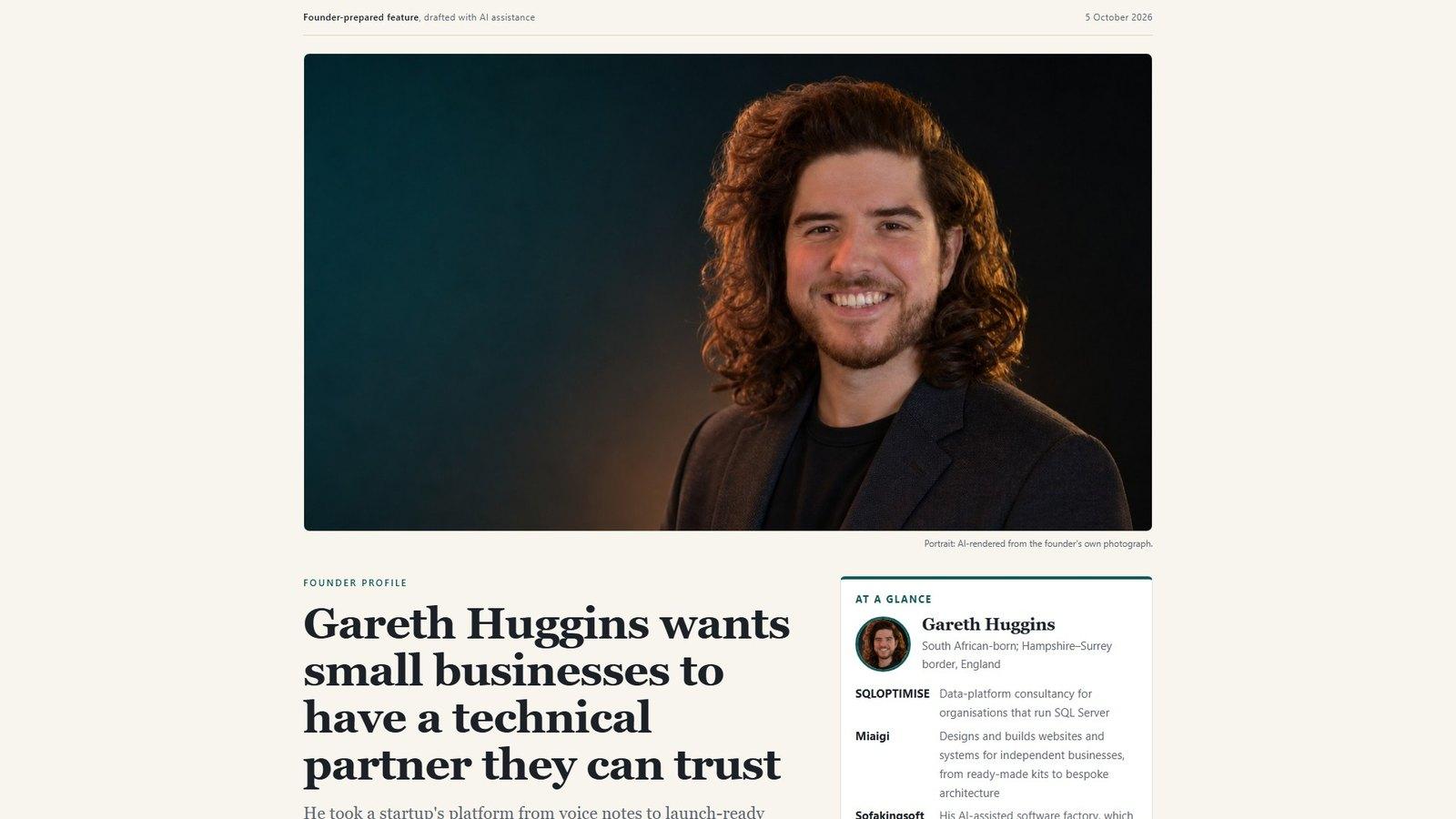
Portrait: AI-rendered from the founder's own photograph.
The stage introduction the workflow made for this feature: an arena announcer, a track generated for it, my own sites behind the type, and my AI-rendered portrait at the name. Made with the open-source /brag skill by Shunit Haviv Hakimi and Hyperframes; voice and music by ElevenLabs. Every line it says is in the verification sheet.
Most founder profiles are one of two things. Puff, written to impress and impossible to check. Or an audit, so hedged that nobody finishes it. I wanted a third thing: a profile I would be proud to share, with the receipts a sceptic would ask for.
So I built a tool to write one, and I made myself the first test.
What it does
Founder of the Year is a skill for Claude Code, Anthropic's command-line AI coding tool. The name is a creative brief, not a prize: it tells the AI to write in the register of an award profile, and then to earn every sentence.
It works in six steps:
- Set up. Read whatever already exists: a brief, an earlier draft, notes from a previous conversation.
- Gather first. Before asking the founder anything, find out what it can reach: a notes vault, a CRM, GitHub, the company's own websites, the public company register, LinkedIn. Then read what those sources already know. Everything read-only, with a filter that drops anything that looks like a password or a key before a file is opened.
- Ask once. Turn what the sources could not say into one short batch of questions, each with a sensible default, and carry on under the defaults until the answers come.
- Choose the story. List three or four angles, judge them on evidence and reader interest, pick one.
- Write it. A real magazine structure: headline, standfirst, an at-a-glance panel, case-study panels, a timeline, pull-quotes only where the words are exact. Delivered as a web page, a PDF and plain text.
- Check and hand over. One evidence check (does any sentence say more than its source?), one editorial read (would a stranger enjoy it and believe it?), then a verification sheet that says, for every consequential claim, what it rests on.
That last part is the point. The article reads confidently because the caveats live somewhere else, where an editor can find them.
What it refused to say
Running it on myself was humbling in a useful way.
It would not use any of the numbers on my own websites, because it could not substantiate them from the page. (Those numbers are being fixed; the skill opened the issues.) It would not quote anything I said in an interview, because the interview was paraphrased from voice notes, so nothing was verbatim. The only quotations in the finished piece are my team's written motto and a recommendation a former manager published on LinkedIn, word for word.
It would not name a client without permission, so the two case studies are businesses that already appear on our own case studies page. It would not say my software factory built a startup's platform, because it did not: an external agency did the engineering, and the factory's part was reviewing their code against my requirements and standards. It wrote that down exactly, and it reads better for being true.
And when a public LinkedIn page offered a photo that turned out to be someone else, the fix was a rule: no portrait is rendered until the founder has confirmed the reference image is them. The portrait at the top of this post is AI-rendered from my own photograph, and it says so under the picture.
What came out
A seven-page feature about the three businesses I run and the startup platform I carried from the founders' voice notes to launch-ready after two developers walked away. You can read the feature here or download it as a PDF. Beside it, a verification sheet with twenty-eight entries. Bios, a fact sheet, a pitch that has not been sent, and the stage-introduction video at the top of this post, announcer and all, made by the same workflow with a script tied line by line to that sheet.
Why this matters if you run a small business
The discipline that made the profile honest is the same one we apply to client work at Miaigi: write the plan down before building, keep a record of what each thing rests on, and let a person have the final say. It is why every bespoke build starts with a written blueprint, and why the software factory behind our sites never lets an agent publish, merge into a client's site, speak to a client or move money on its own. I wrote about that rule in Approval Workflow for Software Development.
If you are a founder and you want a profile you can stand behind, the skill is open source. Point it at your own notes and code, answer one batch of questions, and read what comes back. The bits it refuses to say will tell you something.
Links. The feature, its verification sheet and the PDF. The skill on GitHub: DEX-CON-ONE/founder-of-the-year. The video is on my LinkedIn.
Founder-prepared, drafted with AI assistance. The portrait is AI-rendered from the author's own photograph.